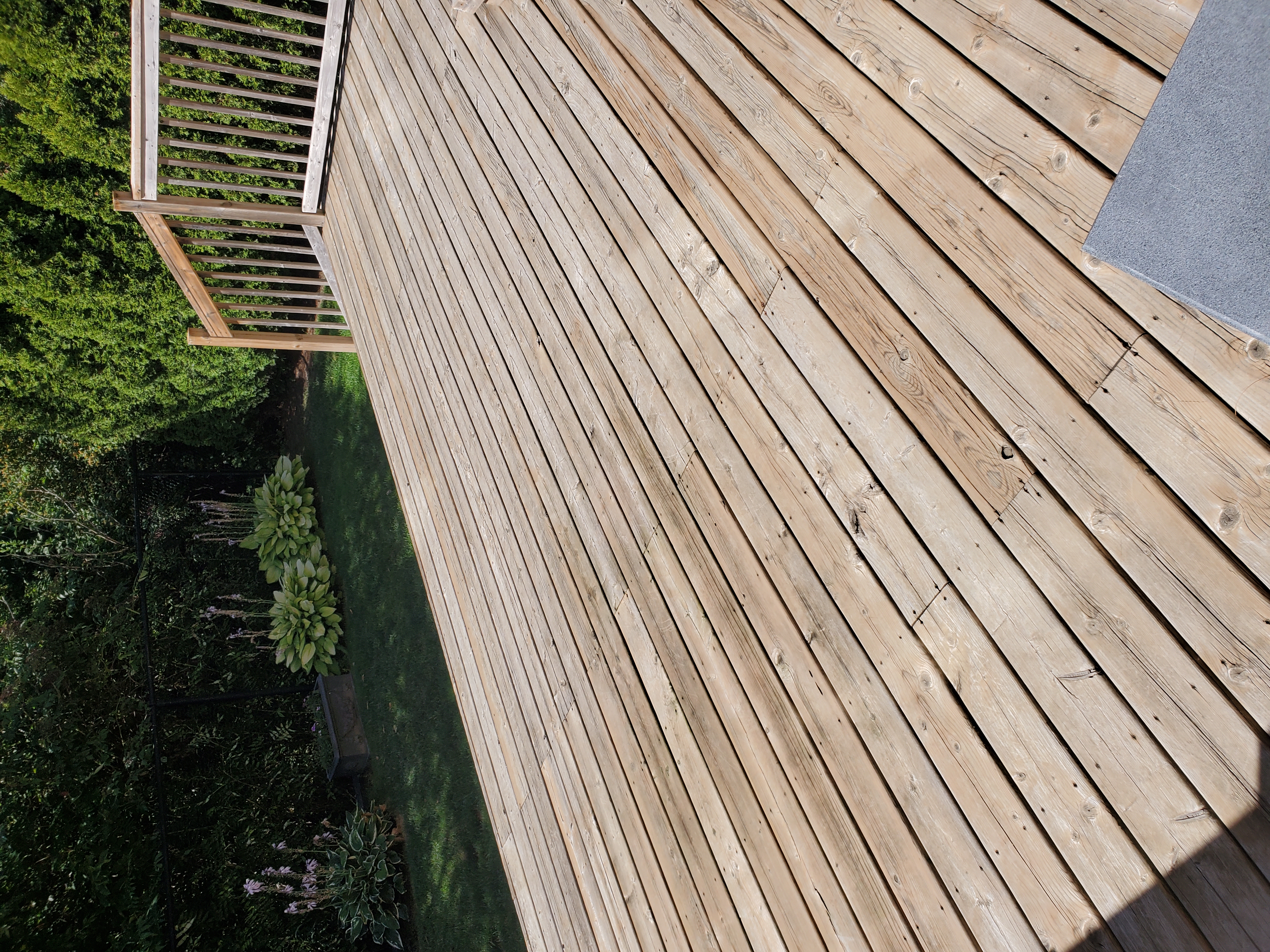
If your deck is looking rough — boards are greying, the surface is rough underfoot, maybe there's some rot in a spot or two — the first question most GTA homeowners ask is whether to fix it or tear it down and start over. The answer isn't always obvious, and the wrong call either way costs money unnecessarily.
Here's how to actually evaluate your deck and make the right decision.
Start With the Structure, Not the Surface
The surface of a deck — the decking boards you walk on — is the least important part of the decision. Boards can be replaced individually or entirely without touching the structure. What determines whether a deck is worth restoring is what you can't easily see: the framing, the posts, and the footings.
Check the posts and beam
Probe the base of every post where it meets the deck framing with a screwdriver or awl. Sound wood resists penetration. Soft wood that gives easily is rotting from the inside — and a rotting post is a structural failure waiting to happen. If posts are rotting at the base, the cost of sister-posting or replacing them tips the math toward replacement.
Check the ledger board
The ledger is the board that attaches the deck frame to your house. It's the most critical connection point and the most common failure location because moisture gets trapped between the ledger and the house wall. A rotted ledger is a serious safety issue — a deck can separate from the house suddenly under load. If the ledger is compromised, you're looking at a significant structural repair regardless of what else you do.
Check the joists
Look at the ends of the joists — the horizontal framing members that the decking sits on. End grain absorbs water fastest and is where rot typically starts. Bounce gently on different sections of the deck — soft spots or excessive flex indicate compromised joists beneath. If more than 20–30% of the joists show significant rot or damage, frame replacement makes more sense than repair.
Check the footings
Push on the posts and look for movement at grade. If posts are moving, the footings may be heaving or inadequate. In Ontario, footings that were installed too shallow heave every winter — the deck moves slightly each year and connections loosen over time. Properly set footings below the frost line don't move.
When Restoration Makes Sense
If the structural frame — posts, beam, ledger, and joists — is in sound condition, restoration is almost always the right call economically. The cost of new decking boards, sanding, and two coats of stain is a fraction of full replacement. The deck looks brand new from above, and you've preserved years of useful life in a solid frame.
Signs restoration is the right choice:
- Posts and beam are solid when probed
- Ledger is firmly attached with no rot or water damage
- Joists are structurally sound (minor surface weathering is fine)
- Footings are not heaving or showing movement
- Boards are grey and weathered but structurally intact
- Deck is less than 20 years old with a known maintenance history
When Replacement Makes Sense
If the structure is compromised, restoration is throwing money at a problem that will reappear. You're better off building once properly than patching repeatedly.
Signs replacement is the right choice:
- Posts are soft or rotting at the base
- Ledger shows rot or has separated from the house
- More than 30% of joists are damaged
- Footings are heaving or posts are visibly moving
- Deck is 25+ years old with no maintenance history
- The layout no longer works for how you use your outdoor space
The hybrid option: In many cases the right answer is partial replacement — new decking boards and staining over a sound existing frame, combined with replacing individual damaged joists or posts rather than the entire structure. This is often the most cost-effective approach for decks where the frame is mostly sound but has isolated damage. We assess every job this way and give you an honest recommendation.
What Does Deck Restoration Actually Cost vs. Replacement?
For a 200–300 sq ft deck in the GTA:
- Pressure wash + 2-coat stain (boards intact): $800–$2,000
- Full board replacement + stain (frame intact): $4,000–$8,000
- Full deck replacement (new frame + boards + railing): $12,000–$22,000
If your frame is solid, restoration at $800–$2,000 is an obvious choice over $15,000 replacement. If your frame is failing, spending $4,000 on new boards that sit on bad structure is money wasted — replacement is the right call.
Deck Assessment, Restoration & Replacement
Across the GTA
We come out, assess the structure honestly, and tell you what actually makes sense — restore, partial repair, or replace. No upselling. Free on-site assessments across Toronto, Vaughan, Mississauga, Brampton, Richmond Hill and the GTA.
Request a Free Assessment ↗ Call (416) 709-0909