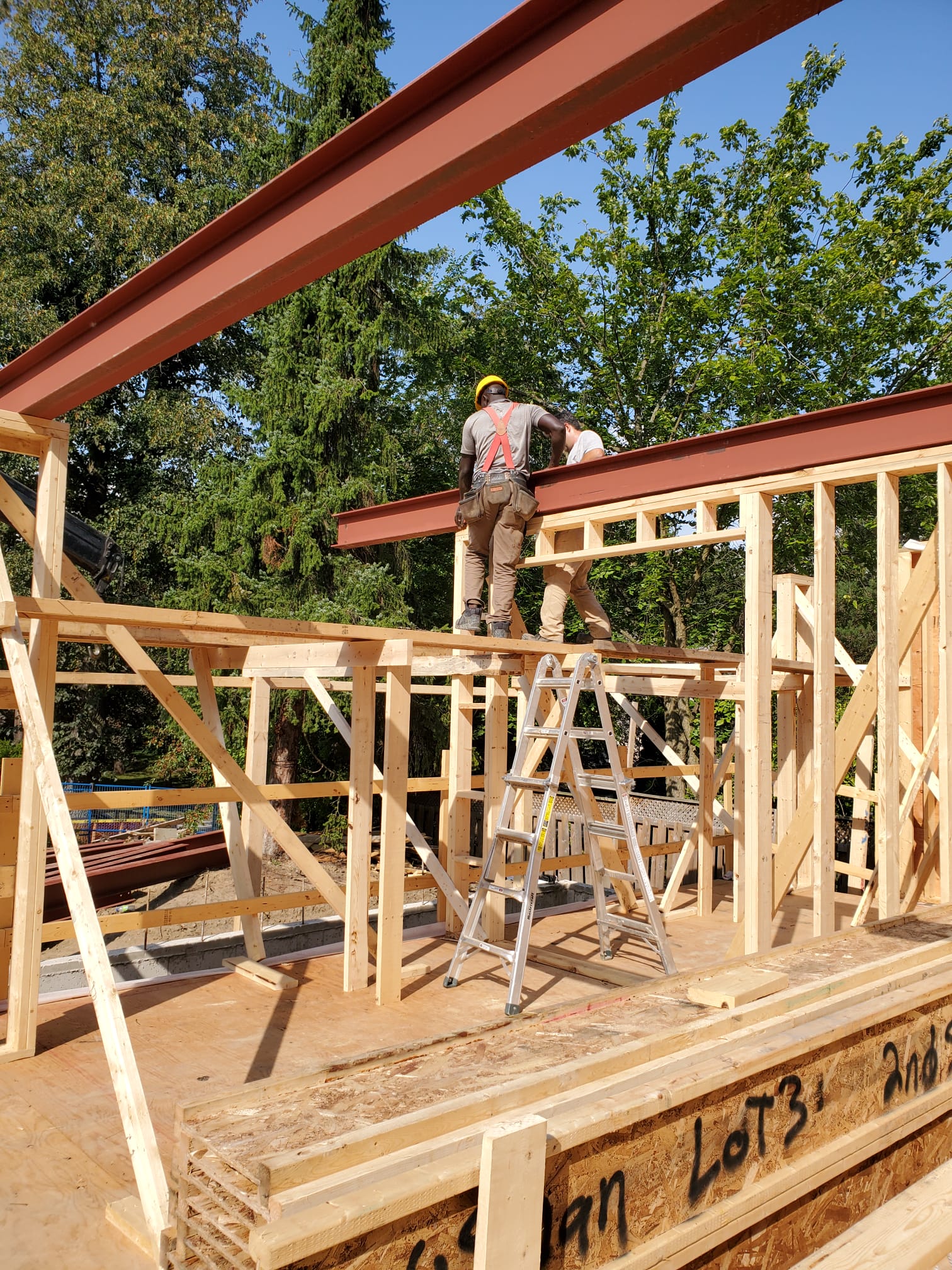
If you've ever gotten a framing quote or reviewed construction drawings, you've likely seen the term LVL — Laminated Veneer Lumber. It shows up in beam specifications, floor systems, and header designs across GTA home builds and renovations. Understanding what it is, how it differs from traditional dimensional lumber, and when one is preferred over the other helps you ask better questions and make more informed decisions about your project.
What Is LVL?
Laminated Veneer Lumber is an engineered wood product made by bonding multiple thin layers of wood veneer together with adhesive under heat and pressure. The grain of each layer runs in the same direction — parallel to the length of the beam — which is what gives LVL its exceptional strength and stiffness relative to its size.
LVL is manufactured in a controlled factory environment where every variable — moisture content, veneer quality, adhesive distribution, and pressing pressure — is precisely controlled. The result is a product with consistent, predictable structural properties that traditional lumber, being a natural material, simply can't match.
What Is Traditional Dimensional Lumber?
Traditional dimensional lumber is sawn directly from logs and dried to a target moisture content. Common species used in GTA framing include SPF (Spruce-Pine-Fir) and Douglas Fir. It's graded visually and mechanically, but natural variability — knots, grain irregularities, moisture variation — means individual pieces can differ significantly in actual strength from their grade designation.
Side-by-Side Comparison
| Factor | LVL | Traditional Lumber |
|---|---|---|
| Strength consistency | Very high — engineered to spec | Variable — natural material |
| Span capability | Longer spans at smaller depth | Shorter spans for same depth |
| Warping / twisting | Minimal — very stable | More susceptible over time |
| Moisture resistance | Better — sealed veneers | More vulnerable |
| Cost | Higher upfront | Lower upfront |
| Availability | Good — standard at suppliers | Excellent — widely available |
| Cutting / modification on site | Can be cut, not easily modified | Very flexible on site |
| Best application | Beams, headers, long spans | Wall framing, joists, general use |
When LVL Is the Right Choice
Long spans with minimal depth
The most common reason LVL is specified is when you need to span a large opening — a wide garage door, an open-plan living area, a basement with no intermediate columns — without a beam so deep it eats into your ceiling height. LVL can carry significantly more load over a longer span than a dimensional lumber beam of the same depth.
Headers over large openings
In GTA homes, window and door openings are increasingly wide. The header above these openings carries the load of the structure above — and for wide openings, LVL headers provide the necessary strength in a depth that fits within the wall framing without requiring a thicker wall or a drop below the ceiling line.
Floor beam applications
In basement finishing and addition projects, LVL is frequently used for the main carrying beams in floor systems. Its dimensional stability — it doesn't shrink, warp, or crown the way dimensional lumber can over time — means floors built on LVL stay flatter and quieter over the long term.
Where engineer specification requires it
On permitted projects in Ontario, the structural engineer's drawings will specify whether a beam is to be LVL, steel, or dimensional lumber. When the drawings say LVL, that's what gets installed — substituting dimensional lumber for a specified LVL beam is a code violation and a structural risk.
When Traditional Lumber Is the Right Choice
Traditional dimensional lumber remains the standard for most wall framing, stud work, blocking, and general structural applications. It's cost-effective, easy to work with on site, and more than adequate for the loads it's typically asked to carry in residential construction.
For standard 2x4 and 2x6 wall framing, using LVL instead of dimensional lumber would be both unnecessary and prohibitively expensive. The right material for each application is what good framing practice looks like.
GTA note: Ontario's winter climate — with its humidity swings and freeze-thaw cycles — does put dimensional lumber framing through real moisture stress over time. In areas with chronic moisture exposure (basement perimeter walls, crawl spaces, areas with past water infiltration), pressure-treated lumber or LVL is often the better long-term choice over standard SPF.
Does It Affect Cost?
Yes — LVL costs more per linear foot than dimensional lumber, sometimes significantly. However, in applications where LVL is specified, the comparison isn't really LVL vs. dimensional lumber. It's LVL vs. a much larger dimensional lumber beam, or vs. a steel beam, both of which have their own cost implications. When LVL is the right solution for a span, it's often the most cost-effective way to achieve it.
A qualified framing contractor will specify the right material for each application — maximising dimensional lumber where it's appropriate and using engineered products where they're required. Over-engineering adds cost; under-engineering creates risk. The goal is the right material in the right place.
Free On-Site Estimate
Across the GTA
Our framing team has an engineering background and works from proper structural specifications on every project. Serving Toronto, Vaughan, Mississauga, Brampton, Richmond Hill and the GTA.
Request a Free Quote ↗ Call (416) 709-0909