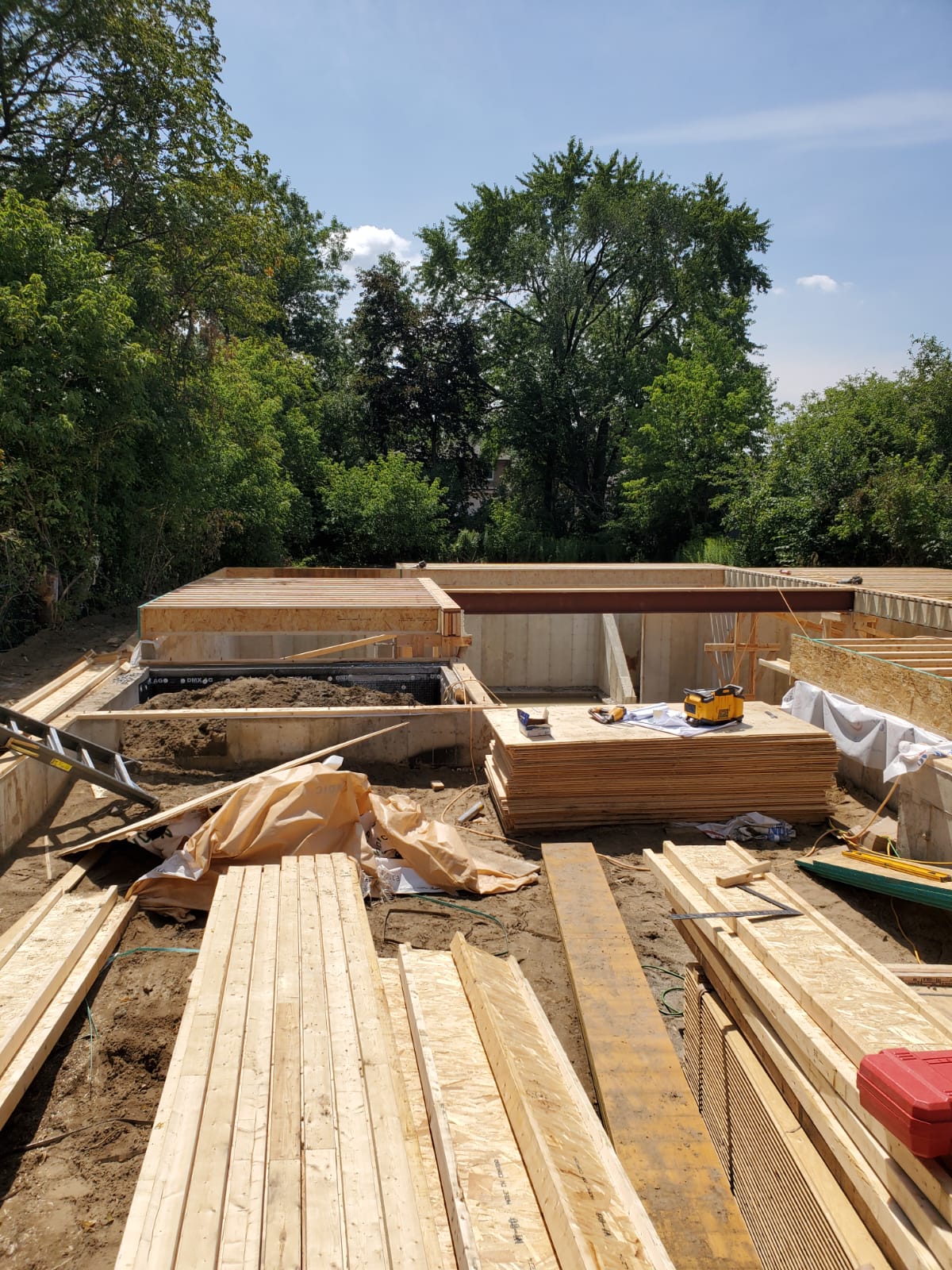
Adding space to your home is one of the most significant investments a GTA homeowner can make — and framing is the skeleton that everything else hangs on. Whether you're adding a main floor extension, a second storey, a garage with living space above, or an in-law suite, the framing phase determines the structural integrity, the layout, and ultimately the livability of everything that follows.
Here's what home addition framing actually involves, what drives the cost, and what GTA homeowners should know before starting.
Types of Home Additions in the GTA
Main floor extensions
The most common type — expanding the footprint of your home at ground level. This involves foundation work first (typically a new concrete foundation or piers), followed by framing the new floor system, walls, and roof. The connection point between the old structure and the new addition is structurally critical and requires careful framing to ensure continuity and prevent differential movement.
Second storey additions
Building up rather than out. This is more structurally complex than a main floor addition because the new weight is being transferred down through the existing walls and foundation. Before framing begins, an engineer must confirm the existing structure can handle the new load — or specify what reinforcement is required. This engineering assessment is not optional.
Garage additions with living space above
Popular in the GTA as a way to add a rental unit, in-law suite, or home office without expanding the main footprint. The garage structure needs to be engineered for the live load above — a standard garage slab and framing is not adequate for occupied space overhead without specific design.
Rear lane / garden suites
Increasingly permitted in Toronto and many GTA municipalities as secondary dwellings. These are essentially small separate structures on the same property and require full foundation, framing, mechanical, and permit work as a standalone build.
The Framing Process for a Home Addition
1. Engineering and design
Before a single stud goes up, the addition needs engineered drawings. This includes structural calculations for beams, headers, connections to the existing structure, and any point loads. These drawings are required for the building permit and form the basis of everything the framing crew builds to. Skipping proper engineering on an addition is not a shortcut — it's a liability.
2. Connection to existing structure
Where the new framing meets the old is the most technically demanding part of an addition. The existing sheathing, framing, and sometimes foundation must be opened up and modified to create a structurally continuous connection. This work needs to be done carefully — water infiltration at addition connections is a common failure point when the integration isn't properly detailed and flashed.
3. Floor system framing
For a main floor addition, this means framing the floor system above the new foundation — typically engineered floor joists at modern spans, which are stiffer and more consistent than dimensional lumber. For a second storey, this means framing a new floor over the existing main floor walls.
4. Wall framing
Exterior and interior walls are framed to the engineered layout, with headers sized for all window and door openings. For additions with large window openings or open-plan layouts, engineered beams (LVL or steel) are often required to carry the loads that would otherwise be distributed across multiple studs.
5. Roof framing
Roof framing for additions is more complex than new construction because it needs to integrate with the existing roofline. Matching pitch, connecting ridge lines, and ensuring proper drainage all require careful planning and execution. Poor roof framing at an addition junction is the most common source of long-term water damage in addition projects.
What Does Home Addition Framing Cost in the GTA?
Addition framing costs vary significantly based on size, complexity, storey count, and the structural challenges involved. As a general framework for the GTA in 2026:
- Small single-storey addition (200–400 sq ft) — framing labour and materials typically in the $15,000–$30,000 range
- Medium single-storey addition (400–700 sq ft) — $25,000–$50,000+ depending on complexity
- Second storey addition — framing alone often $40,000–$80,000+, highly dependent on existing structure and engineering requirements
- Garden suite / laneway house — complete framing packages typically $35,000–$70,000+ for the structure alone
Important context: Framing is typically 15–25% of the total addition budget. A complete addition — including foundation, framing, insulation, mechanical, drywall, windows, roofing, and finishing — costs significantly more. Get a complete scope from your contractor, not just a framing-only number, so you understand the full investment.
Permits — What's Required for a Home Addition
Home additions require a building permit in all GTA municipalities without exception. The permit application requires architectural and structural drawings, and depending on the scope, may also require a site plan showing the addition's relationship to property lines and setbacks.
Setback requirements vary by municipality and zone — how close you can build to your property line, rear yard, and neighbours directly affects what addition is possible. Confirming zoning compliance before designing is essential; a design that doesn't meet setbacks can't be permitted, regardless of how well it's built.
For second storey additions and garden suites, additional reviews and approvals may be required. Your contractor should have experience navigating the permit process in your specific municipality.
What to Look for in an Addition Framing Contractor
- Experience with additions specifically — addition framing is meaningfully more complex than new construction framing. Ask specifically about their addition experience
- Comfort working with engineers — legitimate addition contractors work from engineered drawings and ask questions when something in the field doesn't match the drawings
- References on completed addition projects — ask to see finished work, not just framing-stage photos
- Clear scope of work — exactly what is and isn't included in the framing price, including temporary weatherproofing during construction
- Insurance and WSIB coverage — non-negotiable for any work on your home
Free On-Site Estimate
Across the GTA
We assess your property, review your plans, and give you a clear written quote on home addition framing. Serving Toronto, Vaughan, Mississauga, Brampton, Richmond Hill and the GTA.
Request a Free Quote ↗ Call (416) 709-0909